Suzanne Sadedin, Ph.D. in evolutionary biology from Monash University
I’m so glad you asked. Seriously. The answer to this question is one of the most illuminating and disturbing stories in human evolutionary biology, and almost nobody knows about it. And so, O my friends, gather close, and hear the extraordinary tale of:
HOW THE WOMAN GOT HER PERIOD
Contrary to popular belief, most mammals do not menstruate. In fact, it’s a feature exclusive to the higher primates and certain bats*. What’s more, modern women menstruate vastly more than any other animal. And it’s bloody stupid (sorry). A shameful waste of nutrients, disabling, and a dead giveaway to any nearby predators. To understand why we do it, you must first understand that you have been lied to, throughout your life, about the most intimate relationship you will ever experience: the mother-fetus bond.
Isn’t pregnancy beautiful? Look at any book about it. There’s the future mother, one hand resting gently on her belly. Her eyes misty with love and wonder. You sense she will do anything to nurture and protect this baby. And when you flip open the book, you read about more about this glorious symbiosis, the absolute altruism of female physiology designing a perfect environment for the growth of her child.
If you’ve actually been pregnant, you might know that the real story has some wrinkles. Those moments of sheer unadulterated altruism exist, but they’re interspersed with weeks or months of overwhelming nausea, exhaustion, crippling backache, incontinence, blood pressure issues and anxiety that you’ll be among the 15% of women who experience life-threatening complications.
From the perspective of most mammals, this is just crazy. Most mammals sail through pregnancy quite cheerfully, dodging predators and catching prey, even if they’re delivering litters of 12. So what makes us so special? The answer lies in our bizarre placenta. In most mammals, the placenta, which is part of the fetus, just interfaces with the surface of the mother’s blood vessels, allowing nutrients to cross to the little darling. Marsupials don’t even let their fetuses get to the blood: they merely secrete a sort of milk through the uterine wall. Only a few mammalian groups, including primates and mice, have evolved what is known as a “hemochorial” placenta, and ours is possibly the nastiest of all.
Inside the uterus we have a thick layer of endometrial tissue, which contains only tiny blood vessels. The endometrium seals off our main blood supply from the newly implanted embryo. The growing placenta literally burrows through this layer, rips into arterial walls and re-wires them to channel blood straight to the hungry embryo. It delves deep into the surrounding tissues, razes them and pumps the arteries full of hormones so they expand into the space created. It paralyzes these arteries so the mother cannot even constrict them.
What this means is that the growing fetus now has direct, unrestricted access to its mother’s blood supply. It can manufacture hormones and use them to manipulate her. It can, for instance, increase her blood sugar, dilate her arteries, and inflate her blood pressure to provide itself with more nutrients. And it does. Some fetal cells find their way through the placenta and into the mother’s bloodstream. They will grow in her blood and organs, and even in her brain, for the rest of her life, making her a genetic chimera**.
This might seem rather disrespectful. In fact, it’s sibling rivalry at its evolutionary best. You see, mother and fetus have quite distinct evolutionary interests. The mother ‘wants’ to dedicate approximately equal resources to all her surviving children, including possible future children, and none to those who will die. The fetus ‘wants’ to survive, and take as much as it can get. (The quotes are to indicate that this isn’t about what they consciously want, but about what evolution tends to optimize.)
There’s also a third player here – the father, whose interests align still less with the mother’s because her other offspring may not be his. Through a process called genomic imprinting, certain fetal genes inherited from the father can activate in the placenta. These genes ruthlessly promote the welfare of the offspring at the mother’s expense.
How did we come to acquire this ravenous hemochorial placenta which gives our fetuses and their fathers such unusual power? Whilst we can see some trend toward increasingly invasive placentae within primates, the full answer is lost in the mists of time. Uteri do not fossilize well.
The consequences, however, are clear. Normal mammalian pregnancy is a well-ordered affair because the mother is a despot. Her offspring live or die at her will; she controls their nutrient supply, and she can expel or reabsorb them any time. Human pregnancy, on the other hand, is run by committee – and not just any committee, but one whose members often have very different, competing interests and share only partial information. It’s a tug-of-war that not infrequently deteriorates to a tussle and, occasionally, to outright warfare. Many potentially lethal disorders, such as ectopic pregnancy, gestational diabetes, and pre-eclampsia can be traced to mis-steps in this intimate game.
What does all this have to do with menstruation? We’re getting there.
From a female perspective, pregnancy is always a huge investment. Even more so if her species has a hemochorial placenta. Once that placenta is in place, she not only loses full control of her own hormones, she also risks hemorrhage when it comes out. So it makes sense that females want to screen embryos very, very carefully. Going through pregnancy with a weak, inviable or even sub-par fetus isn’t worth it.
That’s where the endometrium comes in. You’ve probably read about how the endometrium is this snuggly, welcoming environment just waiting to enfold the delicate young embryo in its nurturing embrace. In fact, it’s quite the reverse. Researchers, bless their curious little hearts, have tried to implant embryos all over the bodies of mice. The single most difficult place for them to grow was – the endometrium.
Far from offering a nurturing embrace, the endometrium is a lethal testing-ground which only the toughest embryos survive. The longer the female can delay that placenta reaching her bloodstream, the longer she has to decide if she wants to dispose of this embryo without significant cost. The embryo, in contrast, wants to implant its placenta as quickly as possible, both to obtain access to its mother’s rich blood, and to increase her stake in its survival. For this reason, the endometrium got thicker and tougher – and the fetal placenta got correspondingly more aggressive.
But this development posed a further problem: what to do when the embryo died or was stuck half-alive in the uterus? The blood supply to the endometrial surface must be restricted, or the embryo would simply attach the placenta there. But restricting the blood supply makes the tissue weakly responsive to hormonal signals from the mother – and potentially more responsive to signals from nearby embryos, who naturally would like to persuade the endometrium to be more friendly. In addition, this makes it vulnerable to infection, especially when it already contains dead and dying tissues.
The solution, for higher primates, was to slough off the whole superficial endometrium – dying embryos and all – after every ovulation that didn’t result in a healthy pregnancy. It’s not exactly brilliant, but it works, and most importantly, it’s easily achieved by making some alterations to a chemical pathway normally used by the fetus during pregnancy. In other words, it’s just the kind of effect natural selection is renowned for: odd, hackish solutions that work to solve proximate problems. It’s not quite as bad as it seems, because in nature, women would experience periods quite rarely – probably no more than a few tens of times in their lives between lactational amenorrhea and pregnancies***.
We don’t really know how our hyper-aggressive placenta is linked to the other traits that combine to make humanity unique. But these traits did emerge together somehow, and that means in some sense the ancients were perhaps right. When we metaphorically ‘ate the fruit of knowledge’ – when we began our journey toward science and technology that would separate us from innocent animals and also lead to our peculiar sense of sexual morality – perhaps that was the same time the unique suffering of menstruation, pregnancy and childbirth was inflicted on women. All thanks to the evolution of the hemochorial placenta.
So there has been a bit of “what if humans were the weird ones?” going around tumblr at the moment and Earth Day got me thinking. Earth is a wonky place, the axis tilts, the orbit wobbles, and the ground spews molten rock for goodness sakes. What if what makes humans weird is just our capacity to survive? What if all the other life bearing planets are these mild, Mediterranean climates with no seasons, no tectonic plates, and no intense weather?
What if several species (including humans) land on a world and the humans are all “SCORE! Earth like world! Let’s get exploring before we get out competed!” And the planet starts offing the other aliens right and left, electric storms, hypothermia, tornadoes and the humans are just … there… counting seconds between flashes, having snowball fights, and just surviving.
To paraphrase one of my favorite bits of a ‘humans are awesome’ fiction megapost: “you don’t know you’re from a Death World until you leave it.” For a ton of reasons, I really like the idea of Earth being Space Australia.
Earth being Space Australia
Words cannot express how much I love these posts
Alien: “I’m sorry, what did you just say your comfortable temperature range is?”
Human: “Honestly we can tolerate anywhere from -40 to 50 Celcius, but we prefer the 0 to 30 range.”
Alien: “……. I’m sorry, did you just list temperatures below freezing?”
Human: “Yeah, but most of us prefer to throw on scarves or jackets at those temperatures it can be a bit nippy.”
Other human: “Nah mate, I knew this guy in college who refused to wear anything past his knees and elbows until it was -20 at least.”
Human: “Heh. Yeah everybody knows someone like that.”
Alien: “……. And did you also say 50 Celcius? As in, half way to boiling?”
Human: “Eugh. Yes. It sucks, we sweat everywhere, and god help you if you touch a seatbelt buckle, but yes.”
Alien: “……. We’ve got like 50 uninhabitable planets we think you might enjoy.”
“You’re telling me that you have… settlements. On islands with active volcanism?”
“Well, yeah. I’m not about to tell Iceland and Hawaii how to live their lives. Actually, it’s kind of a tourist attraction.”
“What, the molten rock?”
“Well, yeah! It’s not every day you see a mountain spew out liquid rocks! The best one is Yellowstone, though. All these hot springs and geysers from the supervolcano–”
“You ACTIVELY SEEK OUT ACTIVE SUPERVOLCANOES?”
“Shit, man, we swim in the groundwater near them.”
Sounds like the “Damned” trilogy by Alan Dean Foster.
“And you say the poles of your world would get as low as negative one hundred with wind chill?”
“Yup, with blizzards you cant see through every other day just about.”
“Amazing! when did you manage to send drones that could survive such temperatures?”
“… well, actually…”
“… what?”
“…we kinda……. sent……….. people…..”
“…”
“…”
“…what?”
“we sent-”
“no yeah I heard you I just- what? You sent… HUMANS… to a place one hundred degrees below freezing?”
“y-yeah”
“and they didn’t… die?”
“Well the first few did”
“PEOPLE DIED OF THE COLD AND YOUR SOLUTION WAS TO SEND MORE PEOPLE???!?!?!?”
My new favorite Humans are Weird quote
“PEOPLE DIED OF THE COLD AND YOUR SOLUTION WAS TO SEND MORE PEOPLE?”
aka The History of Russia
aka Arctic Exploration
aka The History of Alaska
Being from Alaska, this was sort of how I felt going to college in the lower 48′s and learned that no one else had been put through a literal survival camp as a regular part of their school curriculum, including but not limited to:
1. Learning to recognize all forms of animal tracks in the wild so you can avoid bears and moose and search out rabbits and other small animals to eat.
2. Extensive swimming and climbing on glacial pieces with competitions to see who could last the longest, followed by a group sit in the sauna so we wouldn’t get hypothermia (no, not kidding, I really did this many times as a kid!)
3. How to navigate using the stars to get back to civilization.
4. How to select the right type of moss from the trees to start a fire with damp wood (because, y’know, you’re in a field of snow. Nothing is dry.)
5. How to carve out a small igloo-like space to sleep in the snow to preserve body heat and reduce the windchill so you won’t freeze to death in the arctic.
“I’m telling you, I don’t think we need to worry about territory conflicts with the humans. You know all those deathtrap hell-worlds in the Argoth Cluster?” “Those worthless rocks? Yeah.” “80% of them are considered ‘resort destinations’ by those freaky little primates.”
This would be an interesting read if this was a book.
Like, an alien invasion is about to start and the book is a chronicle of how the aliens couldn’t handle both humans in general and the range of environments and ended up being destroyed through the eyes of one of the aliens.
Like a caption from the book would be something like
“So we sent a recon team to this place called Russia, but all we’ve heard back thus far is about the temperatures, giant monsters with fur the humans call “Bears”, and that once again, we have been reminded of how heavily well armed almost ever human settlement is.
Thus far we have lost more than a good chunk of our forces through experiments gone wrong, unsuccessful fire fights, and above all else, the humans seem to be more worried about these strange variation of their species calling themselves “Clowns”.
I don’t know what a Clown is, but sounds as if it is the dominant faction of this planet, and considering we only just found out humans practically poison themselves with this thing called beer and only get stronger and more violent, I don’t ever want to encounter such a being.
I believe this invasion was a mistake.“
I’ve been reading a bunch of these and all I can think about now is aliens finding out about our insane ability to walk away from accidents.
“Human Colony SDO435**, this is Gxanimi survey vessel 3489. We regret that we must inform you that the wreckage of your ship ‘Gecko Flyer’ has just been detected on planet F56=K=. We offer expressions of sympathy for this catastrophe.”
“Shit, thanks for telling us, we’ll be right there.”
“Why?”
“To find our people, of course.”
“… you wish to retrieve the corpses for your traditional death rituals, of course, we understand. We have sent the coordinates.”
“What do you mean, bodies? No survivors at all? There must be some.”
“Official mouthpiece of Human Colony SDO435**, the ship has crashed. It has impacted the planet’s surface at speed. Moreover, this might have happened as much as five vek ago. We do not understand why you speak of ‘survivors’.”
“Oh, there’ll be survivors. There always are.”
“(closes hyperspace voicelink) How sad that they are unable to accept the reality of their loss.”
*
“Hey, Gxanimi survey vessel 3489, thanks for letting us know about the Gecko Flyer. More than half the crew made it!”
“Made what?”
“They survived! A couple of lost limbs and so on, but they’ll be fine.”
“… but that vessel was destroyed! Images have been examined!”
“Oh, well, everyone in the fore-below compartment was crushed, obviously, but the others made it out.”
“… but the crash was vek ago! Excuse we… at least eighty of your ‘days’! How could they survive without a ship? Without shelter and supplies?”
“Well, the wreckage gave them some shelter, and of course the emergency supplies kept them going until they could start growing stuff. It’s actually a nice little planet, they said. Quite a lot of edible flora and fauna. T-shirt weather, in summer, too.”
“What is… t-shirt weather?”
“Oh, you know, when it’s comfortable to go around with only modesty covering over the epidermis. Exposed limbs.”
“That planet is so cold that even water solidifies in its atmosphere!”
“Well, in winter, obviously. But we like that. Listen, our people have been raising crops down there, and that’s usually how we rule a planet as ‘colonized’…. is anyone else using it, or can we call it?”
“Er… we have claimed the warmer planets in the system, but we believe we could come to some arrangement.”
*
It was really nice, the humans thought, how carefully most of the aliens kept an eye out for downed ships after that, once they found out that humans tended to survive anything less than explosive decompression or… well, explosions generally. They’d immediately inform the nearest outpost of a wreck’s location, or even ship survivors back themselves. It was very thoughtful.
They didn’t find out until a long time later that the Gxanimi had put out the word to every species they were in contact with. It was vital that everyone knew the things they had learned about humans after that first encounter.
1. Humans can literally walk away from an impact that renders a space-worthy hull so much scrap and would have actually liquefied a Gxanimi.
2. Humans will eat just about anything not immediately fatal to them – including, in extremis, the corpses of their dead crewmates. In fact, most human vessels keep a list of those willing to be eaten and those whose socio-religious scruples forbid it. They have a ridiculously high tolerance for dangerous substances, and if they can breathe on a planet they can probably eat something on it too. They also have something they call the ‘Watney Protocol’, which requires them to carry live soil samples, seeds, and simple tools that will allow them to start farming their own native foodstuffs on any remotely habitable planet immediately in the event of an accident.
3. Once they’ve farmed a planet, they bond with it. They’ll be polite, but it’ll take significant effort to get rid of them even so.
Conclusion: If a human ship crashes on a planet you like and want to keep, get other humans to come and get them immediately. Remove them yourself if you have to. Even the worst crash can result in a thriving colony in a few vek.
And don’t, for the love of gravitational regularity, try to solve that problem by killing off the survivors. Just don’t. It won’t work and it just makes all the rest of them mad.
This is the best one yet!
This made me sudden think about how any sort of semi-organic robotic life forms and humans would bond over adaptability and liking to soak in the same kinda mineral and other stuff rich/laced heated pools.
The rest of the Universe is terrified.
“You know those terrifying living metal creatures that can live in almost any environment?”
“Yeah?”
“The humans made friends with them. They have set up immigration treaties.”
Apparently, radio waves broadcast out into space. So what if Earth is the planetary equivalent of that arsehole neighbour blasting shitty music at 3am?
It takes light-years to reach anyone capable of picking it up, but when they do it’s like we’re playing Skrillex, Beethoven, the Wiggles and Metallica simultaneously, at full volume with maximum bass.
Imagine Earth’s first contact being the intergalactic equivalent of Noise Control showing up to make us turn down our damn stereo so the rest of the galaxy can get some sleep.
i think the moment i was disillusioned about life was when i was maybe 7 years old and realized the reason all my friends had become assholes was because boys aren’t allowed to have any physcial contact that isn’t fighting
my parents were hippie feminists so my brother and i could play clapping games and sleep in puppy piles and give each other weird hairdos, but all the ‘normal’ boys just up and stopped knowing how to touch anyone without hitting sometime between kindergarten and first grade
and my little kid mind briefly saw the vastness of life stretching out in front of all of us, and all the hugs everyone would need and not get, and for a moment i was just like
maybe life is not such a good idea after all
I grew up around a Russian ballet school. Let me tell you something about Russian men: They touch each other. Especially dancers, who are in my experience almost always super tactile people. They rough house like Americans, but they also hug each other, and sit on each other’s laps, and share blankets when it’s cold backstage.
So I grew up knowing full well that the whole Men Don’t Touch thing was puritanical bullshit.
What I was absolutely not prepared for, however, is the super intense effect it has on straight men’s romantic relationships.
Because when you are literally the only person it is okay for your boyfriend to touch, Jesus fucking Christ, that changes the game.
I strongly suspect that a lot of Str8 Dude feelings of entitlement to women’s bodies, particularly the bodies of their wives and girlfriends, is a direct result of those women being the only non-violent physical contact they’re allowed to have.
I know for certain that the framing of any and all platonic physical contact as un-manly has been directly responsible for a lot of sexual dysfunction (and then the attendant misery of trying to get that treated at the ripe old age of 22) with at least one of my exes. It’s a mess when you can’t get it up because you’re depressed and want to be held but you’ve been brainwashed into thinking what you actually want is sex because being held is for girls.
Amazing how the erectile dysfunction went completely away when he learned the difference between feeling horny and feeling cuddly. /sarcasm
“I strongly suspect that a lot of Str8 Dude feelings of entitlement to women’s bodies, particularly the bodies of their wives and girlfriends, is a direct result of those women being the only non-violent physical contact they’re allowed to have.”
Omfg
No wonder the worst of them seem crazy… profound isolation does exactly that
When I taught in Japan, the boys were all super comfortable with each other. They’d sit on laps and hug and roughhouse and it wasn’t seen as bad ? Like it surprised me at first, but then you realize the problem is with so many men feeling that they have to prove… something? I dunno. I personally don’t like hugs or touches, but that is my own personal reasons and nothing of how I was brought up.
Because when you are literally the only person it is okay for your boyfriend to touch, Jesus fucking Christ, that changes the game.
Things I never thought of…I couldn’t imagine if my husband were the only person I was allowed to touch. As I think on it, that extends to the kids, too. The dudes aren’t allowed to really even cuddle their own damned children or nieces and nephews.
Wow.
Also explains why western media romanticizes co-dependency in romantic relationships to such an insane degree.
Random Headcanon: That Federation vessels in Star Trek seem to experience bizarre malfunctions with such overwhelming frequency isn’t just an artefact of the television serial format. Rather, it’s because the Federation as a culture are a bunch of deranged hyper-neophiles,
tooling around in ships packed full of beyond-cutting-edge tech they
don’t really understand. Endlessly frustrating if you have to fight
them, because they can pull an effectively unlimited number of bullshit
space-magic countermeasures out of their arses – but they’re as likely
as not to give themselves a lethal five-dimensional wedgie in the
process. All those rampant holograms and warp core malfunctions and
accidentally-traveling-back-in-time incidents? That doesn’t actually
happen to anyone else; it’s literally just Federation vessels that go off the rails like that. And they do so on a fairly regular basis.
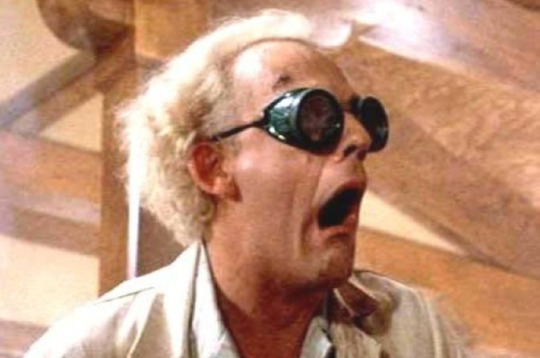
So to everyone else in the galaxy, all humans are basically Doc Brown.
Aliens who have seen the Back to the Future movies literally don’t realise that Doc Brown is meant to be funny. They’re just like “yes, that is exactly what all human scientists are like in my experience”.
THE ONLY REASON SCOTTY IS CHIEF ENGINEER INSTEAD OF SOMEONE FROM A SPECIES WITH A HIGHER TECHNOLOGICAL APTITUDE IS BECAUSE EVERYONE FROM THOSE SPECIES TOOK ONE LOOK AT THE ENTERPRISE’S ENGINE ROOM AND RAN AWAY SCREAMING
vulcan science academy: why do you need another warp core
humans: we’re going to plug two of them together and see if we go twice as fast
vsa: last time we gave you a warp core you threw it into a sun to see if the sun would go twice as fast
humans: hahaha yeah
humans: it did tho
vsa: IT EXPLODED
humans: it exploded twice as fast
I love this. Especially because of how well it plays with my headcanon that the Federation does so much better against the Borg than anyone else because beating the Borg with military tactics is nigh-impossible, but beating them with wacky superscience shenanigans works as long as they’re unique wacky superscience shenanigans.
Yeah, I love this.
Reminds me of the thing I wrote a while back about Humans in high fantasy realms – they’re basically Team Fuck It Hold My Beer I Got This.
Impulsive, passionate to a fault, the social structures they build to try and regulate this hotheadedness ironically creates even greater levels of sheer bull-headedness. Even their “cooler” heads take action in months or weeks.
All their great heroes of the past were impossibly rash by galactic standards. Humans Just Go With It, which is their great flaw but also their greatest strength.
klingons: okay we don’t get it
vulcan science academy: get what
klingons: you vulcans are a bunch of stuffy prisses but you’re also tougher, stronger, and smarter than humans in every single way
klingons: why do you let them run your federation
vulcan science academy: look
vulcan science academy: this is a species where if you give them two warp cores they don’t do experiments on one and save the other for if the first one blows up
vulcan science academy: this is a species where if you give them two warp cores, they will ask for a third one, immediately plug all three into each other, punch a hole into an alternate universe where humans subscribe to an even more destructive ideological system, fight everyone in it because they’re offended by that, steal their warp cores, plug those together, punch their way back here, then try to turn a nearby sun into a torus because that was what their initial scientific experiment was for and they didn’t want to waste a trip.
vulcan science academy: they did that last week. we have the write-up right here. it’s getting published in about six hundred scientific journals across two hundred different disciplines because of how many established theories their ridiculous little expedition has just called into question. also, they did turn that sun into a torus, and no one actually knows how.
vulcan science academy: this is why we let them do whatever the hell they want.
klingons: …. can we be a part of your federation
Humans: so, uh, funny story
Vulcan Science Academy: Let us guess – you’re not here to return the two warp cores we loaned you for experimentation, and you’re here to tell us that both of them were destroyed at once while you were trying to turn a sun into a torus again
Humans: well, half right
VSA: Wait, what is this
Humans: This is sixteen warp cores
VSA: How is this
Humans: Turns out that at the center of the stellar toroid there was a subspace anomaly that—
VSA: PLEASE don’t
Humans: —caused a refractive tachyon emission that—
VSA: This is literally impossible in every sense of the word
Humans: — depolarized the warp fields and in short—
VSA: Just no
Humans: — the warp fields got cloned and we ended up with four.
VSA: But you brought back sixteen
Humans: We had to repeat the experiment a couple of times to make sure it wasn’t a fluke
there’s an educational trivia game at the citadel on the exhibits on different planets called “Dog or Not?” that shows pictures of various four legged mammals and asks if they’re a breed of dog.
it was mainly for kids to learn about the diversity of earth’s flora and fauna but it became popular with adult aliens too and had to be shut down after almost causing no less than three diplomatic incidents.
they brought it to the nexus and it’s caused two more so far
“That’s definitely a dog.” “Incorrect. This is actually an animal called a ‘raccoon’” “What? No! It’s got the ears and the tail!”
“Okay, okay, I got this. That’s not a dog. It’s way too big it’s uhhh I think humans call them bears.” “Incorrect. This is a dog breed called a ‘newfoundland’”
And when it becomes such a cultural obsession that they run tournaments and the final rounds are displayed live on the worldswide hologram system …
Somewhat cocky contestant (who heckles the others for wrong answers) looks at the hologram on display: “I’ve read up on a lot of Earth animals, even visited the Earth zoo, so you can’t fool me. It’s a picture on a farm so that’s the first clue. It’s white, fluffy, got a sloping forehead and no distinct… muzzle.. if I do remember the term correctly. It’s most definitely a sheep.”
Trivia host (attempting to hide their joy at finally being able to tell the contestant they’re wrong): “I’m sorry, that is a dog called a Bedlington Terrier. It is actually bred to look like a sheep, but notice the lack of keratinized tissue coverings on the extremities that make contact with the ground. You missed quite an obvious difference there.” (after the contestant stutters a bit and protests about dogs made specifically to look like not-dogs) “Let’s take it to the judges then” (after consulting small podium-top hologram of judging panel, now grinning and dripping with sarcasm) “Awwww…unfortunately it is a dog and rules of the game do not allow us to award partial credit… toooooo baaaaaad” (super cheerfully) “aaand… next image please!”
Shepard loves “Dog or Not?”. The human crew never misses a tournament airing. They get it on a vid screen in the mess hall and all crowd around. Some people bring blankets and pillows. Some make snacks to share. Eventually it becomes like a Superbowl party.
Dog or Not becomes a sort of inside joke on the Normandy, one that the non-human crew members still kind of get – they’re always invited to the viewing parties and sometimes sit in – but don’t really understand. Tali especially doesn’t understand when a snickering Shepard elbows her and, pointing to a varren being taken for a walk, asks, “Hey, Tali – dog or not?”
“That’s…that’s a varren, Shepard,” Tali responds, bemused. “You know what a varren is.”
Shepard is still giggling, and Kaidan, who heard the exchange, joins in.
–
Liara, Ashley, and Shepard go to recover the lost data drive at Admiral Hackett’s request. They eventually find themselves surrounded by the strange monkey-looking organisms.
With a straight face, Ashley comments, “Wow, sure are a lot of dogs on this planet.”
Shepard doubles over. Liara isn’t sure whether or not to laugh. She’s watched “Dog or Not?” before, so she knows these creatures aren’t dogs…right?
–
Garrus accidentally joins in on the fun after they discover a new species on a fog-covered planet. They’re bright red, they have carapaces, and they breathe fire. The team is examining one’s corpse when Garrus asks hesitantly, “So…is that a dog?”
Shepard’s head whips up and they stare at him for a full five seconds before breaking down. Garrus has to half-carry a wheezing, crying Shepard back to the shuttle. Jack’s eyelashes are wet from her own mirth.
–
They’re driving full speed over the scorching desert of Tuchanka. They’ve just called Kalros, the mother of all thresher maws, to deal with the Reaper destroyer in their way. All faces are pressed to the windows to see the fight.
Kalros bursts from the sands with an unearthly screech and tackles the Reaper. The two grapple in the sands, both representing the might of organic and synthetic, respectively.
“Garrus,” Shepard says in a low, awed voice.
Garrus has been around Shepard for too long not to know when they’re about to make a joke. “Shepard, I swear on all the spirits of Palaven – “
“That’s the biggest dog I’ve ever seen.”
Garrus quietly regrets all his choices that led him to this moment, then sighs. “Which one?” he returns.
When your politician wants to do the right thing, they need your help. Calls and tweets are very helpful to them. Here’s why:
Politicians can’t just do whatever they want, because they represent us. Whatever they believe personally, they have to take into account what their voters think. Politicians can do some unpopular things, but they have to pick unpopular issues very, very careful, or they lose reelection and can’t do anything at all.
If you call/tweet your representatives about something they already agree with, you are telling them: We have your back. You don’t have to worry that doing the right thing will cost you the election. Doing the right thing will get you votes, and make you *more* likely to win. That gives them more options.
Another way that calling representatives who are on the right side helps them: Representatives can’t pass legislation by themselves. They have to persuade other representatives to vote the right way. There are usually politicians who are on the fence and potentially open to persuasion.
If your representative can say to other representatives: “My phones are ringing off the hook about this issue”, or “My twitter mentions are overwhelmed with people asking me to do this”, it can persuade other politicians that this issue matters to voters. Every representative who can do this makes a difference. A politician may sometimes be in denial about what their constituents are saying; it’s harder to stay in denial if they’re hearing it from multiple politicians whose states/districts are similar to theirs. Even if your representative is unwaveringly on your side and in a safe seat, your calls/tweets can help them to persuade others.
Stories and pictures also matter. Telling stories can persuade politicians to do the right thing. During the health care debates, every politician told stories that a constituent told to them. The vote was close, and the Republicans who voted against it said that stories were part of what convinced them to do the right thing. If you tell your representatives stories about why the issue matters to you, it can help them to act on it, even if they already agree with you.
Tweeting pictures at your representatives can also help. Pictures of protests show politicians that people care enough to show up in person and protest. This suggests to them that people care enough to show up and vote. This is reassuring to politicians who agree with you, and they can use those pictures to put pressure on politicians who aren’t sure how they want to vote. Pictures of real people affected by the issue are also helpful. They show, viscerally, that this is about real people. That can be very persuasive.
Another reason why contacting politicians who agree with you matters: If you make the issue you’re calling/tweeting about a safe issue for them, then they don’t have to spend political capital on it. If they don’t spend political capital on it, then it’s available to spend on a risky issue. Calling/tweeting them helps them to do the right thing about the immediate issues *and* future issues which may be riskier.
Tl;dr: Even if your representatives agree with you, it’s still worth contacting them about important issues. Calling, tweeting, and otherwise contacting them can give them them *ability* to do what they already want to do. Tell them stories. Tweet them pictures that tell stories, including pictures you take at any protests you go to. Scroll up for more explanation of why this matters.


 just moving along like everyone else